

★★★★★
Mimics a mother's coat The faux fur is incredibly plush. Our new puppy settled on his very first night away from his litter without a single whimper.

Amelia C.
✓ Verified buyer
Eight months, three behaviourists and around £600 later, the thing that actually worked cost less than a weekly shop — and it had nothing to do with obedience.


I'm going to admit something I've never said out loud. Eight weeks after we brought Milo home, I sat on the kitchen floor at eleven at night and looked up the rescue centre's return policy.
He was a four-year-old Poodle who'd been in three homes before ours. On paper, perfect — soft, gentle, brilliant with my sister's kids. And the second the front door clicked shut behind me, he fell apart.
The neighbour left a note. Then a second note. I started structuring my whole life around not leaving the house for more than forty minutes, which is not a life, and everyone who has been here knows exactly what I mean.
He wasn't being difficult. He was frightened. And I'd spent months treating a fear problem like a behaviour problem.
Some of it helped a little. None of it touched the actual problem.

Free delivery · 30-day money-back guarantee
The third behaviourist barely asked about Milo's training. She asked one thing: where does he sleep — and I mean where does he actually feel safe, not where you've put a bed?
I pointed at the flat rectangular mattress in the corner. She asked me to look at it properly. Open on all four sides. In the middle of the room. Slid about a foot every time he stepped on it. He'd never chosen to sleep on it — he slept jammed against the sofa, wedged between it and the wall, back covered.
A dog needs somewhere nothing can come at them from behind. Milo had never had one. He'd just been finding the closest thing he could.
I was sceptical too. It sounded like the kind of thing someone tells you when they've run out of ideas. But once she explained it, it was hard to argue with.
1. Enclosure. Dogs are den animals. A raised rim they can tuck their spine and chin against triggers a hardwired signal that says "nothing is behind me — it's safe to switch off". A flat mat gives them none of that.
2. Warmth and contact. Long-pile fur against the body mimics the pressure and heat of sleeping in a litter. It's the same reason weighted blankets work on humans.
3. Consistency. Anxiety runs on unpredictability. A bed that doesn't move, smells the same and lives in the same spot every day becomes a place the dog associates with calm. A bed that slides across the floor never does.
She sent me away with one instruction: get him something enclosed, warm and non-slip, and put it where he already tries to sleep. Not where it looks tidy. I compared about a dozen — most were flat, half were the wrong shape, and the ones that weren't were £150 upwards. I ended up on Google and came across the KovePaws CalmNest and I ordered one in Champagne, size M.

 Bestseller
4 sizes · 5 colours · dispatched in 1–3 working days
He ignored it. Completely. I want to be straight with you about that, because every review I read made it sound instant. I put one of my old t-shirts in it, moved it to the gap by the sofa where he actually slept, and went to bed slightly annoyed with myself.
At about half two in the morning I came down for water and he was in it. Curled, chin on the rim, out cold. He didn't even lift his head.
The pacing stopped first. That was the thing I noticed before anything else — the eight steps back and forth across the living room just weren't happening in the evenings any more. He'd take himself to the bed at around nine and stay there.
I checked the camera after a Tesco run. Nine minutes of alert-but-quiet at the door, then he went to the bed and stayed there for the remaining fifty. No howling. Nothing chewed. That was the first time in eight months I'd seen that.
I'm not going to pretend a bed cured separation anxiety. What it did was give him a place to be anxious in — and that turned out to be most of the battle.
It didn't fix everything overnight, and I'd be lying if I said it did. He still gets unsettled if I'm gone more than three hours, and we still do short departure practice most days.
If your dog's anxiety is severe — self-harm, refusing food, distress that never settles — please talk to your vet. A bed is a foundation, not a treatment. The KovePaws dog anxiety guide is a sensible place to start reading.
What changed was the baseline. He had somewhere to go. Before, when he got stressed, there was nowhere for that to land — so it came out through the skirting board and the front door.
★★★★★
4.8 average from 372 verified reviews
Mimics a mother's coat The faux fur is incredibly plush. Our new puppy settled on his very first night away from his litter without a single whimper.
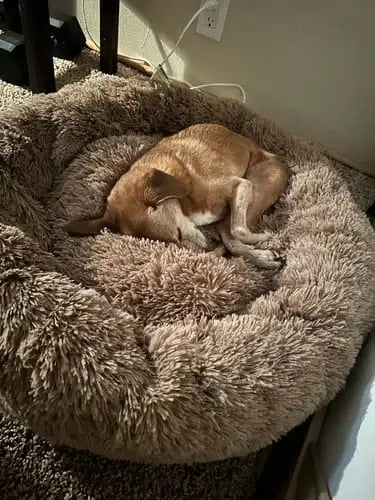
Separation anxiety gone. I used to come home to a stressed, whining dog. Now I find her fast asleep in her favorite nest.

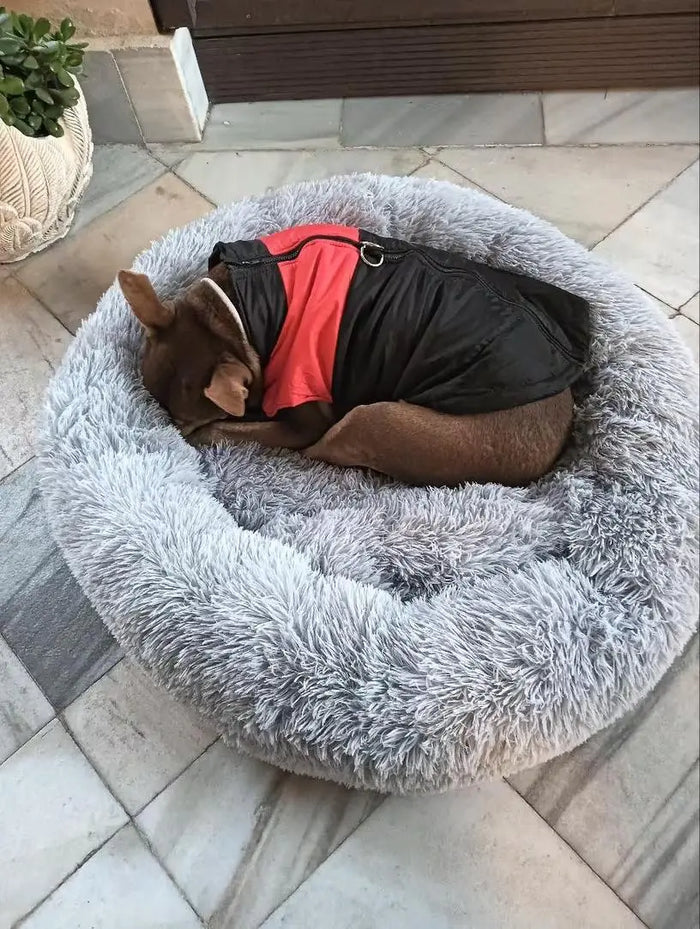
A true luxury upgrade. Beautifully soft and keeps my nervous dog completely serene during rainstorms.

This won't help every dog. It helps a very specific kind. If you're nodding at three or more of these, it's worth trying.
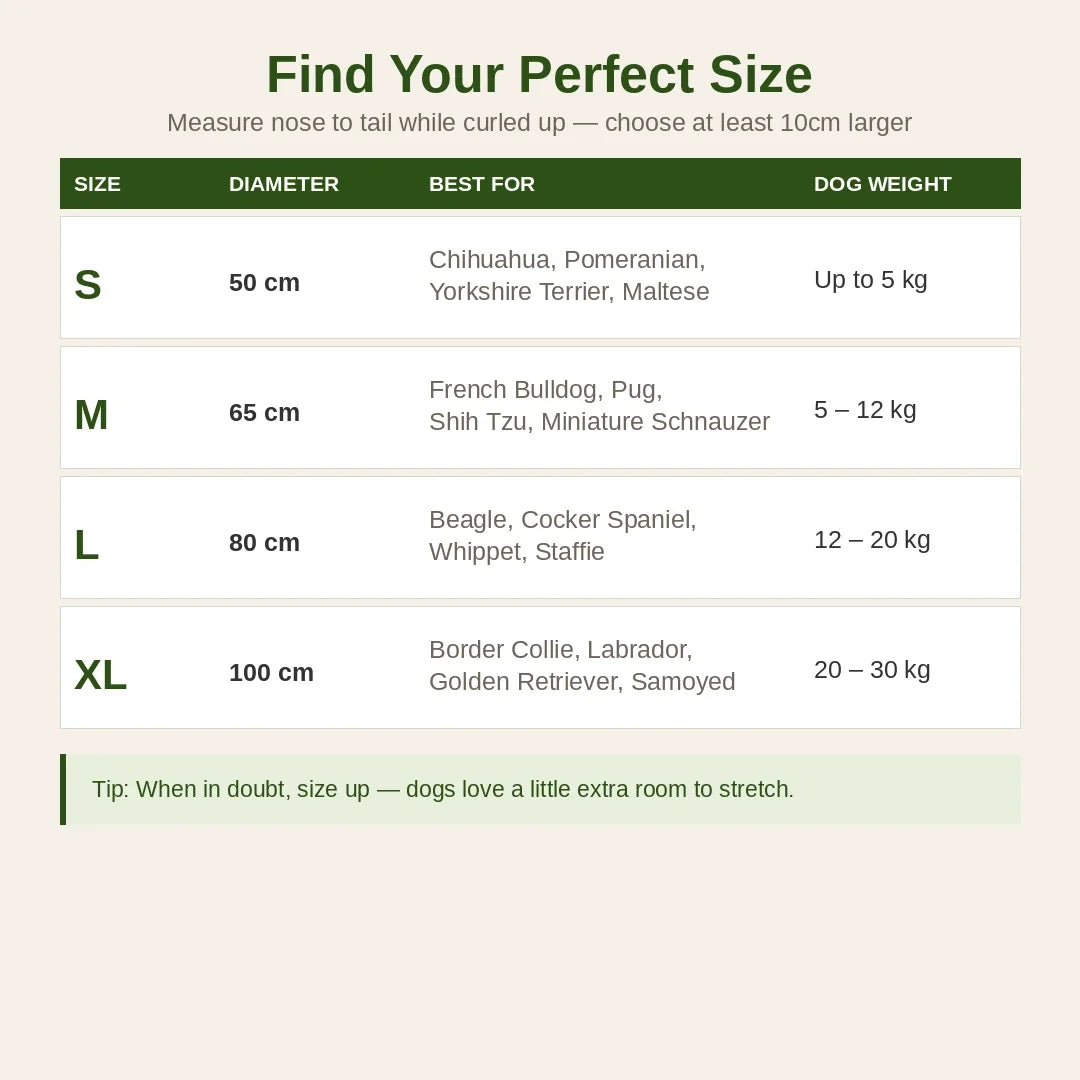
I nearly ordered a size too small. Measure your dog nose-to-tail while they're curled up, then add at least 10cm. If they sleep stretched out rather than curled, size up again — the rim only works if they can rest against it without hanging off the edge.
Not sure which problem you're actually solving? There's a short two-minute quiz that points you at the right thing — it's how I worked out I also needed something for the car, which is a whole other story.
Mine did for a night. Three things fixed it: put it exactly where they already choose to sleep (not where it looks tidy), drop in a worn t-shirt so it smells of you, and don't force them into it. Most dogs investigate it themselves within 24–48 hours.
If it genuinely doesn't work there's a 30-day money-back guarantee — that was the reason I was willing to risk another £80 after the £120 bed disaster.
Genuinely washable. The cover has a zip that runs the full way round, so it comes off in about twenty seconds. Cold wash, gentle cycle, tumble dry low. The inner cushion is spot-clean only — don't put the whole thing in the drum.
Nothing is chew-proof and I wouldn't trust anyone who says otherwise. What I would say is that a lot of chewing is anxiety-driven, and once the bed becomes the calm spot most dogs stop going at it. Supervise the first few days.
The fur is long-pile and breathable rather than sealed, so it holds warmth without trapping it. Milo used it through a British heatwave. If your dog runs genuinely hot, keep it out of direct sun and pair it with something cooling like a ZenLick mat for the hottest part of the day.
It starts at £49.95 for the 50cm and goes up to £94.95 for the 100cm. Delivery is free across the UK and orders go out in 1–3 working days with tracking.
Yes, if it's real separation anxiety. The bed gives your dog somewhere to be — the training teaches them that you coming back is normal. The two together are what worked for us. There's a full walkthrough in the back-to-school anxiety guide, worth reading now if your household routine changes next month.
If your dog paces, can't settle, or falls apart when you leave — start with where they sleep. It was the cheapest thing on my list and the only one that moved the needle.
Find my dog's size →From £49.95 · Free delivery · 30-day money-back guarantee

